|





| |
|
WHAT
IS AIKIDO?
As a new topic,
many students will have conjured up all sorts of thoughts of what
Aikido is, and most of thoughts are probably correct. Aikido
means different things to different people.
To avoid confusion we must first look into its history.
References to the
original form, "AIKI
JUJUTSU", date back to 1150ad.
This fighting form was closely guarded by the heads of Japanese
Clans in Feudal times and was only taught to the knights of the Clan.
The close combat weapons used in those days were, swords,
spears, staffs knives to name a few.
In general fighting was carried out in close quarters.
Today, as we have seen in recent times, battle is fought at
distant and with explosive weapons such as guns & bombs etc.
To use a Martial Art against such devices would be pointless.
So the reasons for learning a Martial Art today are entirely
different from the original reasons. Today it is more about
leisure and in essence the spirit of what once was. From this we
can practise and become skilful with a more useful purpose. This
purpose is the development of body and mind for the good of all.
|
|
|
A SHORT
HISTORY OF KIKUSUI KAI AIKIDO
|
|
Aikido is a Martial Art that has a
history that reaches back to 11th Century Japan. It is system of
training that is attributed to a Samurai General by the name of Shinra
Saburo Yoshimitsu. Having studied many forms of Ju-Jitsu, the general
devised a system of self-defence without weapon, that would provide
his officers with both physical fitness and spiritual well being. This
system, which he named Daitoryu-Aiki-Ju-Jutsu, proved so successful
and valuable that for centuries afterwards it was kept secret and
handed down only through members of the powerful Minamoto family.
Later it was handed down to the Takeda family of the Aizu clan. Dr.
Sogaku Takeda taught the hereditary successor, Professor Morihei
Uyeshiba in 1910 when the professor was 28 years of age.
He too possessed a wide knowledge of
the Japanese martial arts and was expert in many schools of Ju-Jutsu.
His first master in the martial arts was one Tokuzaburo Tozawa who
taught him the forms of the Kito-Ryu school when he was in his teens.
At the age of 20 he studied Yagi-Ryu and early form of fencing from
Masakatsu Nakai. It was Nakai Sensei who taught Uyeshiba to use the
Bokken (Wooden Sword) really well. He also studied Judo with Kiyoichi
Takaki in Wakayama Ken. From all these he took the best of the
techniques he had learned and added to them his mastery of
Daitoryu-Aiki-Ju-Jutsu and so formed his own system, which is now
known as Aikido.
One famous samurai
who has had a deep and lasting influence on the formation of Kikusui
Kai was Masashige
Kusunoki.
He was a powerful symbol of
loyalty to the Emperor Go-Daigo. His heroic
defence of Chihaya Castle became one of the most famous examples of
bushido.
The Kikusui no Mon (the Kikusui Kai emblem or badge) comes
from his family crest, which consists of kiku – chrysanthemum
and sui – water.
|
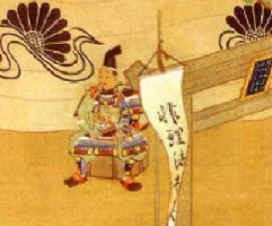
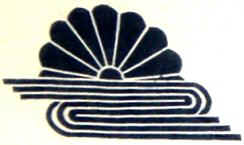
Early forms of the Kikusui no Mon
|
|
|
|
A
translation of old characters which form part of the battle flag of Masashige
Kusunoki.
 |
Injustice,
Atrocity |
 |
Justice,
Reason |
 |
Law |
 |
Authority,
Power |
 |
Heaven,
God |
This
is a explanation of the world order, which reads, “Atrocity cannot
win over Justice. Justice
cannot win over Law. Law
cannot win over Authority. Authority
cannot win over God.” This
teaching dates back to 13th century Japan and may be
difficult to relate to modern times.
A
simpler definition might read:
|
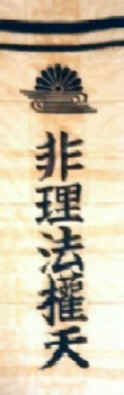
Written
below the Kikusui
no Mon are old style
characters which form part of the battle flag of Masashige
Kusunoki.
|
|
THROUGH
TRUE SPIRIT WE STRIVE EXCELLENCE,
WHICH
PREVAILS OVER INJUSTICE AND INIQUITY
|
| KIKUSUI
KAI BADGE
Today the "Battle Crest" is worn in a much
simpler form and signifies a belonging to and perpetuation of the
great loyalty that was demonstrated by Masashige
Kusunoki.
A modern explanation might be that the
Chrysanthemum shows true natural beauty and the bottom half is the
road leading to this excellence. The blue circle around the
outside represents a circle of friends.
|

|
|
|
|
KIKUSUI
KAI & SHUNPU
KAI - TWINNED
|
|
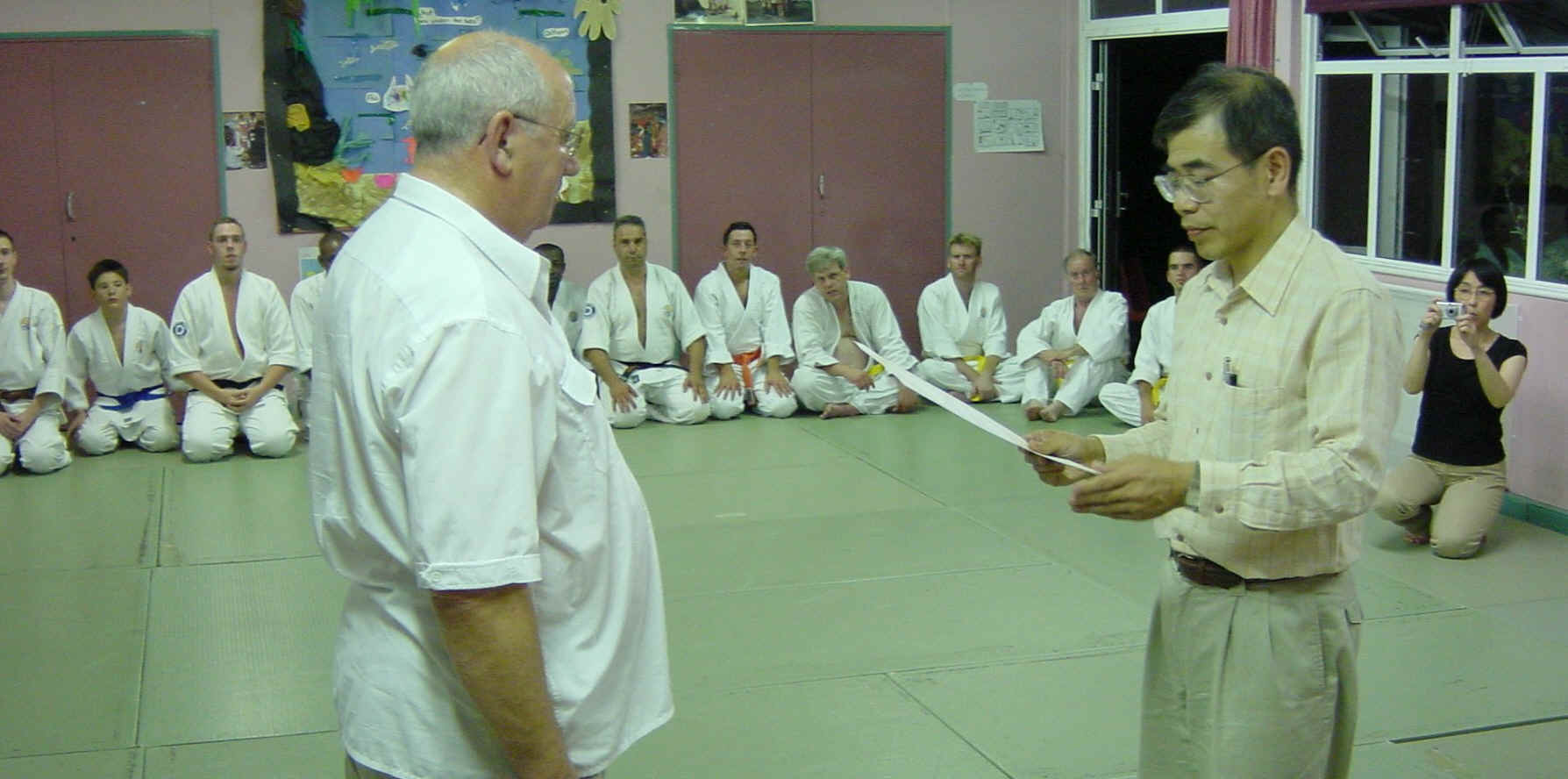
Kikusui Kai members attended the presentation of the
first Anglo-Japanese Friendship Trophy.
It is an idea first conceived by Futami Sensei.
Its purpose is to promote a stronger link between the two
groups, Kikusui Kai & Shunpu Kai.
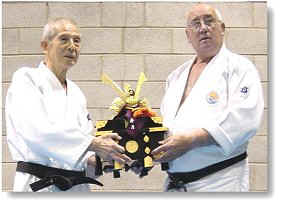
Each year, on the 25th December, the
anniversary of Tomiki Sensei’s passing away; the Kabuto is presented
to the chosen candidate; one nominee being in the UK the other in
Japan.
Sensei Ogi received the sister Kabuto on 30th
November, 2002. On 11th
August, 2003, John Waite was presented with the other Kabuto which he
keeps for one year, before it is passed on to his successor.
This exchange formalises the bond between the two
groups. Both groups
strongly follow the teachings of Professor Tomiki through that of
Yamada Sensei.
Masako Tomiki oversaw the entire ceremony.
As a memento John was awarded a Certificate, which he will
keep.
|

|
|
|
|
|
|
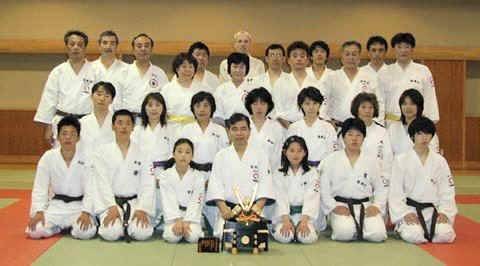
Futami Sensei with the "sister" Anglo-Japanese Friendship Trophy
|
| |
|